

Trees
A poem I learned without trying to memorize. A poet I thought I knew. And the quiet surprise waiting inside both.

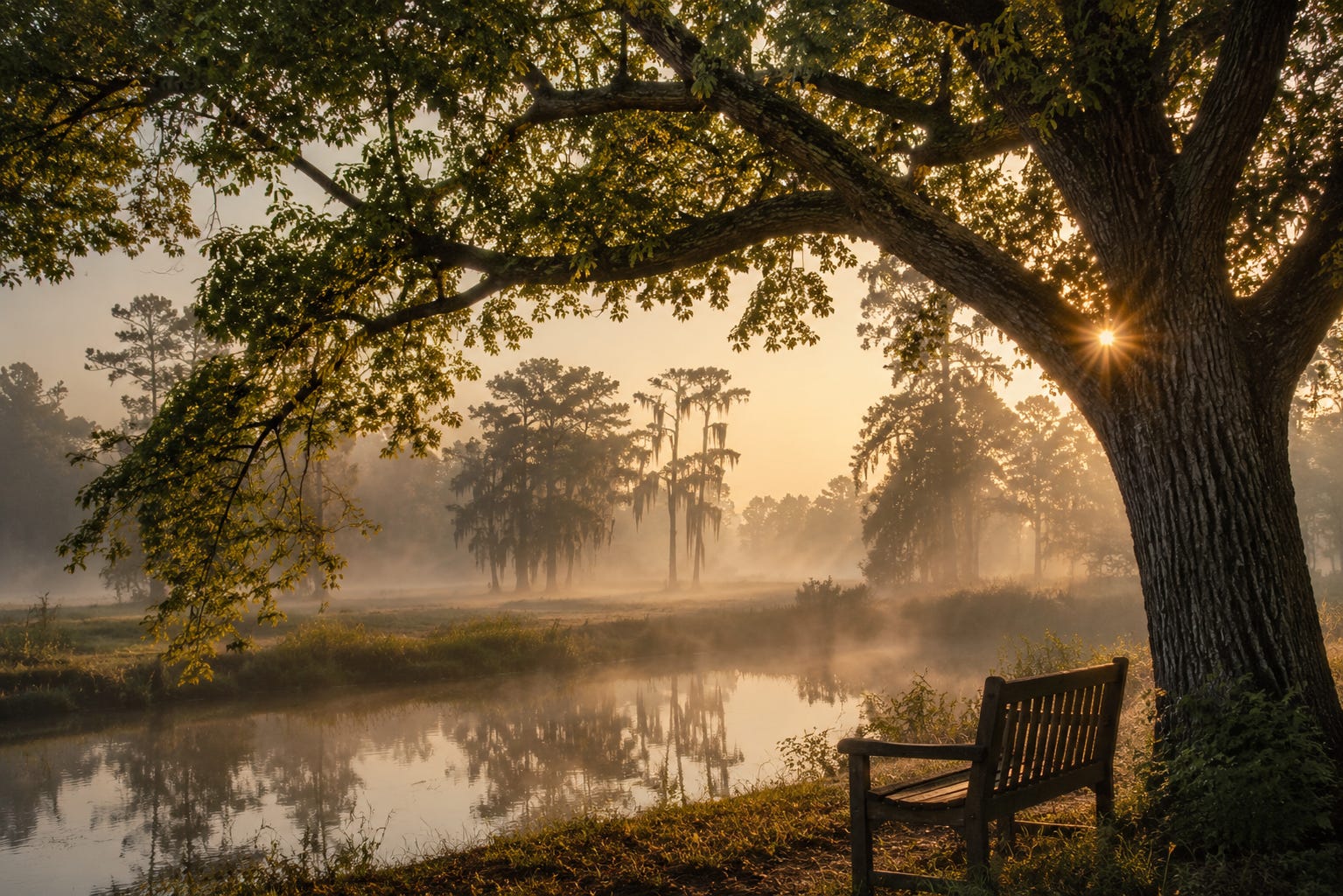
Trees
I think that I shall never see
A poem lovely as a tree.
Trees is the first poem that lives in my memory.
When I wonder how I learned it, I hear my father’s voice reciting it quietly, almost to himself—standing before an autumn maple gone red at the edges, or a great oak shifting in the wind. Sometimes beneath a willow. Always with awe.
I learned the words beside him without instruction.
Without fanfare.
Without him ever knowing I was listening.
I learned rhythm before I knew what rhythm was.
I learned reverence before I knew to call it that.
This morning, with not much pressing to be done, the poem came back fully formed into my mind.
Maybe it was the wind moving through the tupelos along the wetland.
Maybe the pines answering back.
I only know the trees called—and I remembered.
Of course I knew Joyce Kilmer wrote Trees.
But beyond that, almost nothing.
So I did what I always do.
I looked him up.
And what I found startled me—not because it was grand, but because it felt strangely intimate.
For most of my life I believed Joyce Kilmer was English.
Entirely English.
The name.
The poem.
The solemn polished tone of Trees.
Everything about it felt imported to me—mist and hedgerows and rain against old stone walls.
Certainly not New Jersey.
Which, in retrospect, I should have known better than to assume.
After all, there is a Joyce Kilmer Service Area on the New Jersey Turnpike.
We stopped there many times over the years—for coffee, bathrooms, gasoline, and whatever snack seemed necessary to survive the Garden State Parkway-to-Turnpike stretch.
I must have seen his name on the sign again and again without ever connecting it to the poem.
Without ever thinking: That Joyce Kilmer.
The poet was right there between the restrooms and the vending machines, and somehow I still had him living in England among hedgerows and mist.
And yet there he was.
From just around the corner from where my father grew up.
Same streets.
Same seasons.
Likely the same trees.
But it wasn’t geography that caught me.
It was sorrow.
Kilmer’s young daughter Rose was stricken with polio. During that season, he wrote that faith came to him through her—through what he called her “tiny still feet.”
I stopped reading there.
Because suddenly Trees felt different.
Not sweeter.
Stronger.
A prayer written by someone who understood loss and kept loving the world anyway.
And maybe that’s what my father heard in it too.
Not simply beauty.
But endurance.
The kind that bends in wind.
The kind that survives winter.
The kind that remains rooted when life becomes unrecognizable.
Maybe that’s why the poem stayed with him.
And why it stayed with me.
This morning the words returned as if they had been waiting patiently all these years.
And with them came my father’s voice.
Clear as ever.
A poem.
A tree.
A father speaking into the air without knowing his daughter was carrying every word forward.
And now this quiet understanding:
that survival doesn’t always look dramatic.
Sometimes it looks like standing.
Sometimes it sounds like remembering.
Sometimes grace arrives through poetry.
And sometimes, after the deepest loss, life continues the way trees do—
scarred,
weathered,
lifting their arms anyway.
Author’s Note
Some poems live in memory the way certain songs do—you don’t study them so much as absorb them. Trees has stayed with me longer than almost anything I memorized in school. This morning it returned unexpectedly, carried on the wind through the tupelos, and brought my father’s voice with it.
Thank you.